Shenzhen Summit: Trump, Xi, and Putin convene for rare trilateral talks
While APEC leaders debate open trade and AI regulation, the three world leaders meet to address nuclear arms and regional conflicts.
By Mei Chen ·
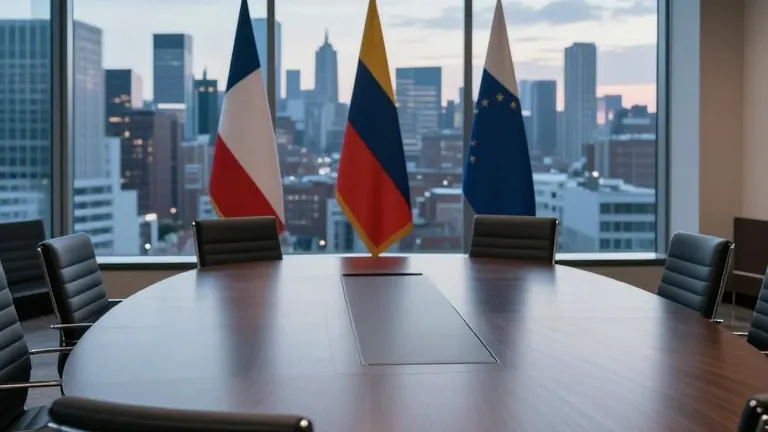
Chinese President Xi Jinping, U.S. President Donald Trump, and Russian President Vladimir Putin began a trilateral summit in Shenzhen on Thursday. This gathering places high-stakes power dynamics at the center of the annual Asia-Pacific Economic Cooperation summit. The meeting follows a day of formal APEC proceedings where the 21 member economies discussed shared interests in open trade and technology development.
The trilateral session is expected to cover nuclear arms control and ongoing conflicts in Ukraine and the Middle East. Trump stated that previous leaders often avoided dialogue with nations holding opposing views. He argued that problems are never solved by refusing to talk. “Let's see if we can get something done,” Trump said as the historic meeting commenced.
Xi urged the APEC group to act as passengers on the same boat, emphasizing the need to join forces to weather Pacific winds and waves. Putin, attending an APEC summit for the first time in nine years, agreed that the organization must set a tone of unity. He called for a constructive agenda for cooperation among members.
Trump used his remarks to highlight the strength of the U.S. economy. He claimed to have brought in trillions of dollars in new investment and created trillions in new wealth. He also pledged to sign more trade agreements in the near future. Trump vowed to oppose globalist efforts to regulate what he calls super intelligence.
Tensions remain regarding artificial intelligence. U.S. restrictions on Chinese access to advanced computer chips continue to irritate Beijing. This issue was recently brought to the forefront by a scandal involving Nvidia founder Jensen Huang and a Chinese technology executive. Washington tightened restrictions on remote access to this technology earlier in the week, closing a loophole that allowed China to acquire billions of dollars worth of Nvidia chips.
Asian leaders, including Xi, have stressed that AI technology must be fairly shared and regulated. They cite the need for financial stability, cybersecurity, and equitable growth. Kristalina Georgieva, managing director of the International Monetary Fund, told the leaders that AI is having a material impact on global growth. She noted that the technology is helping offset energy shocks from the war in the Middle East.
Georgieva reported that the APEC region, which accounts for more than half of global business activity, is growing at an annual pace of 3.4 percent. This slightly exceeds the global growth rate of 3.1 percent. She added that global trade expanded at a rate of 4.6 percent, largely due to the AI investment boom. Georgieva described AI as the most significant factor for medium-term competitiveness and stated that it represents the fastest transformation in human history.