Border Trade: Trucks Roll Again as Paperwork Gridlock Looms
Pakistani exports are moving across the Iranian border after a nine-day halt, but Iranian officials claim new electronic forms are stalling inbound cargo.
By Nathan Cooper ·
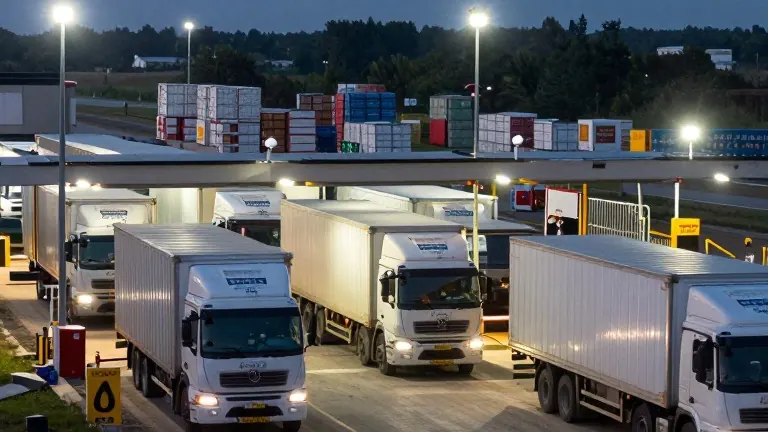
Freight trucks began crossing the Pakistan-Iran border on Monday, ending a nine-day suspension of cargo traffic that left goods stranded at the Gabd-Rimdan and Taftan crossings in Balochistan province.
Mir Naveed Jan Kalmati, president of the Gwadar Chamber of Commerce and Industry, stated that trade partially resumed over the weekend. Border officials confirmed that they cleared consignments dated on or before October 16, allowing Pakistani exports like rice, bananas, and potatoes to move into Iran.
Haji Noor Muhammad Shahwani, central president of the Balochistan Goods Truck Owners Association, reported that trucks loaded in Iran before the closure, including those carrying liquefied petroleum gas, are slowly entering Pakistan. The return of LPG is critical for an economy that imports most of its energy from the Middle East and faced price spikes during the shutdown.
Customs officials instructed agents to file declarations for the stranded vehicles to release them. Rizwan Ahmed, a customs clearing agent near the Gabd-Rimdan crossing, said his own export load of rice and retail goods had just departed. He noted that customs told agents to bring in as much cargo as possible, though he did not specify if this applied to goods loaded after the initial cutoff date.
Iranian authorities dispute the status of the border. Reza Amiri Moghadam, Iran’s ambassador to Pakistan, wrote on X that Tehran placed no restrictions on exports, including LPG. He argued that changes in Pakistan’s implementation of the E-Form procedure for imports have created a situation where traders cannot dispatch cargo from Iran to Pakistan.
A memorandum from Pakistan’s Ministry of Commerce, dated October 16, withdrew a previous waiver for the E-Form, which records imports and bank payments. The change took effect immediately. Moghadam said several hundred LPG trucks had crossed into Gabd but remained unloaded due to banking and clearance issues. Shahwani agreed, suggesting the bottleneck involves international trade banking channels.
The closure followed a security incident on Thursday when gunmen attacked trucks near the Gabd crossing. The military said 10 attackers were killed in operations around Gabd and Gwadar city, and one civilian died. Balochistan recorded 131 armed attacks in September, the highest monthly total in 12 years, according to the Pakistan Institute for Conflict and Security Studies.
Pakistan’s foreign ministry spokesman Sajjad Haider Khan said the country adheres to all applicable sanctions regimes. He did not specify whether the border was fully open or if the United States exerted pressure for the closure. The Ministry of Commerce did not respond to requests for comment.
Source: Al Jazeera