SpaceX sends Starship booster to ocean after failed catch attempt
The upper stage continues its flight to deploy satellites, with a decision on a second catch scheduled for Saturday evening.
By Mei Chen ·
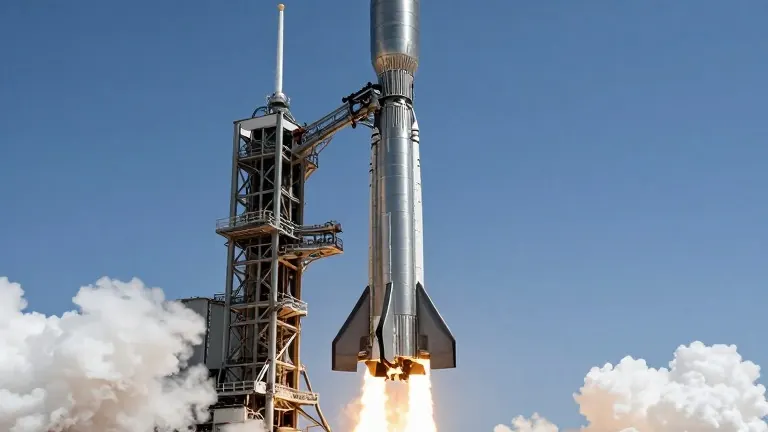
SpaceX directed the lower stage of its Starship rocket into the ocean on Friday, ending an attempt to capture it with the launch tower's mechanical arms. The Super Heavy booster burned up during its descent after the company decided to abort the recovery maneuver. This marks the first time the company has tested a full catch of the vehicle's upper stage, a step required to make the entire rocket reusable.
The 124-meter rocket lifted off from the Starbase facility in Boca Chica, Texas, at 4:45 p.m. local time on Friday. The flight was intended to test the recovery of both the booster and the upper stage, known as the Ship. While previous tests successfully landed the booster three times, the upper stage had only reached orbit for the first time in September. In prior flights, the Ship splashed down in the ocean rather than being caught.
The booster was scheduled to return to the tower six and a half minutes after launch. Instead of aligning with the chopsticks, it was diverted to the sea. A SpaceX spokesperson stated during a live stream that safety was the top priority. The company noted it is still testing maneuvers that have not been performed before on these vehicles and prioritized ensuring each step could be done safely.
The upper stage continued its journey to space. It is currently deploying 26 satellites for the Starlink internet constellation. The Ship is on track to complete 14 orbits around Earth. It will return to the launch tower approximately 22.5 hours after liftoff. SpaceX plans to evaluate the vehicle's condition during this time. A decision on whether to attempt a catch of the Ship is set for around 3:15 p.m. local time on Saturday.
The company has long aimed to build a fully reusable rocket system. In 2015, it became the first firm to vertically land a rocket booster, a feat achieved with its Falcon 9 vehicle. Falcon 9 rockets now fly more than 100 times a year. Reusing the bottom part of the rocket has significantly reduced launch costs. Success with Starship could extend those savings to the larger vehicle.
Prof. Malcolm Macdonald, president of the Royal Aeronautical Society, said full reusability could fundamentally change the economics of accessing space. He noted that one successful flight would not prove the model but could mark a transition from demonstrating that Starship can fly to showing how it could operate. Shareholders will watch the outcome closely after SpaceX went public earlier this year.
The National Aeronautics and Space Administration is also monitoring the test. Starship development affects Nasa's goal to land humans on the Moon by 2028. SpaceX holds a contract to adapt the Ship into a lunar lander. Blue Origin, led by Jeff Bezos, also has a contract to use its New Glenn rocket and lander for the same purpose.
Both companies are involved in Artemis III, currently planned for summer 2027. That mission will see four astronauts in Nasa's Orion spacecraft attempt to dock with both SpaceX and Blue Origin landers. Starship development has been slower than SpaceX intended. Blue Origin also faces delays after a rocket explosion earlier this year destroyed its launchpad in Florida. The company has pushed its return to flight to early 2027.
Nasa Administrator Jared Isaacman has stated that the United States is racing China to the Moon. China plans to land its astronauts on the lunar surface by 2030. Nasa is under pressure to meet its timelines as it coordinates with its commercial partners.