Scientists race to deploy neutrino detectors in Lake Superior before Fermilab beam shifts
A team from the University of Minnesota Duluth and partners is installing five metal towers on the lakebed to catch particles from Chicago, a final opportunity before the accelerator targets South Dakota in February.
By Nathan Cooper ·
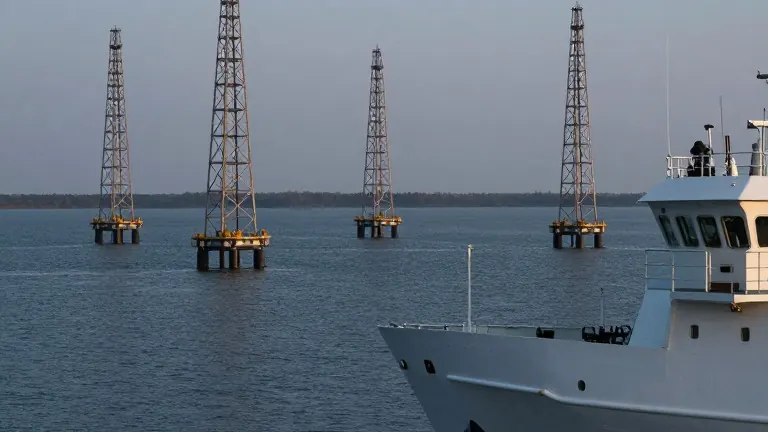
Researchers affiliated with the University of Minnesota Duluth are deploying a network of deep-water sensors along the Duluth port to detect neutrinos emitted by the Fermi National Accelerator Laboratory near Chicago. On Tuesday, Nov. 10, crew members attached photosensors to five three-story-tall metal towers on the docks. The installation marks a critical final window for the experiment.
The primary objective is to observe artificial neutrinos passing through the water of Lake Superior. These particles are fired from the accelerator in Illinois every 1.2 seconds. Because neutrinos possess negligible mass and interact rarely with matter, they traverse the Earth at nearly the speed of light. If the sensors register a hit, it will be the first recorded instance of detecting accelerator-produced neutrinos in a water-based array.
The physics behind the detection relies on a rare interaction. When a neutrino strikes an atom in the water, it emits a faint blue light. The photosensors, sized like exercise balls, are designed to capture that specific flash. Alec Habig, a physics professor at UMD and a principal investigator on the project, noted that neutrinos are fundamental particles that are difficult to study because they pass through conventional detection equipment without leaving a trace.
Time is a strict constraint for the team. The Fermilab beam currently points toward Northeastern Minnesota, but it will be redirected in February to a new laboratory under construction in South Dakota. Habig described the upcoming shift as the team's last chance to gather data with this specific configuration. To maximize their probability of success, the researchers are also installing a different type of sensor in Lake Vermilion. That device will use metal cylinders lined with radiation-sensitive plastic rather than photosensors.
The logistical effort involves Woods Hole Oceanographic Institute’s research vessel, the Neil Armstrong. The 238-foot ship arrived in Duluth earlier this week, marking its first traversal of the St. Lawrence Seaway and Great Lakes. The vessel will begin lowering the towers off the coast of Two Harbors on Thursday. The sensors will be positioned nearly 700 feet below the surface, just over three miles offshore. After placement, the crew will lay more than three miles of fiber optic cable along the lakebed to transmit data to an unused pipe in Two Harbors' water intake facility.
The project is funded by the U.S. Department of Energy's Defense Advanced Research Projects Agency, which has indicated potential military applications. John Bruzzese, a DARPA project manager, stated that while the technology could monitor nuclear submarines or detect weapons programs, the agency does not have a single specific application in mind. He emphasized the need to remain agnostic to allow for a wide range of future possibilities.
The timing of the deployment coincides with heightened global interest in neutrino research. This year's Nobel Prize in Physics was awarded to Francis Halzen of the University of Wisconsin-Madison for his contributions to the IceCube Neutrino Observatory in Antarctica. Terry Benson, a physics lab director at Wisconsin-Madison and a 1999 graduate of Duluth's Denfeld High School, helped build the IceCube sensors. Benson returned to his hometown on Tuesday to assist with the rigging of the new photosensors.
The sensors being deployed in Lake Superior previously operated in the Mediterranean Sea, where they successfully detected naturally occurring neutrinos. Habig noted that previous attempts to detect neutrinos in water, including tests in an Iron Range mine pit, failed due to engineering challenges associated with building large underwater structures. The current setup leverages proven hardware from the Mediterranean array to overcome those earlier obstacles.