Agencies Reassess Control Room Desks to Cut Long-Term Costs
Facilities managers are moving past standard office furniture to specify consoles that survive continuous 12-hour shifts without requiring full room closures.
By Mei Chen ·
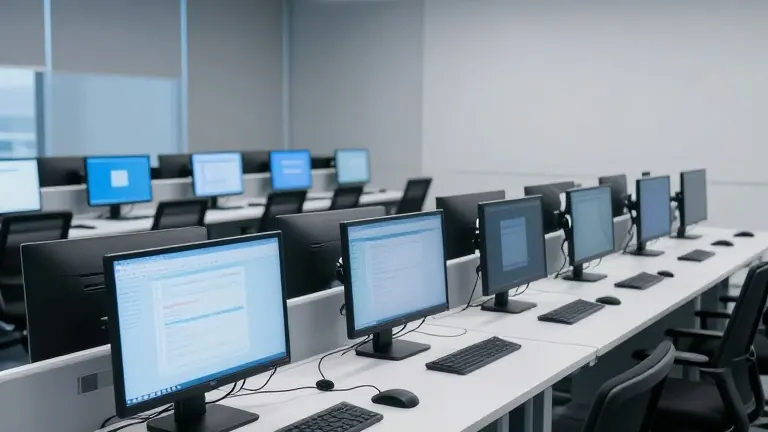
Public safety and healthcare facilities are reevaluating the furniture in their control rooms to reduce long-term maintenance and staffing costs. Agencies that previously treated dispatch consoles as standard office furniture are now specifying equipment engineered for continuous, multi-shift use. This shift aims to prevent the high costs associated with replacing consoles in facilities that cannot afford downtime.
The primary financial driver is the operational continuity of the room. A standard cubicle desk is designed to hold a laptop and a mug, while a dispatch console supports four to six monitors, radio stacks, and phone lines. The source notes that a facility team typically maintains logs for every monitor and server rack but often lacks inspection records for the desks themselves. When a console fails or requires reconfiguration in a building that cannot shut down, the cost of replacement or temporary fixes can be substantial.
Height adjustability is the central feature in these new specifications. The Occupational Safety and Health Administration treats workstation design as a core element of workplace safety, favoring adjustable heights over fixed structures. In a scenario where three dispatchers of different heights use the same console in rotation on a 12-hour overnight shift, static desks force at least two operators into uncomfortable postures. Adjustable desks allow each person to set the surface once and reset it at the next shift change, reducing physical strain and the need for frequent replacements.
Vendors are introducing specific testing protocols to verify that equipment can withstand continuous use. Buyers are advised to ask for actual testing data rather than general claims of durability. The source describes a framework of three checks: sight, reach, and reset. The sight check ensures monitors are within a comfortable viewing arc without neck rotation. The reach check confirms that radios and phones fall within a forearm sweep. The reset check times the height adjustment to ensure it is quick and quiet enough not to disrupt headset audio.
Installation logistics heavily influence the budget and vendor selection. Control rooms in Public Safety Answering Points or hospital reading rooms often cannot go offline for more than a shift, sometimes just hours. The source recommends that buyers ask vendors for references from similar operational facilities and clarify warranty terms. The Centers for Disease Control and Prevention publishes guidance on facility design that helps facilities teams frame these conversations. Buyers should also determine who is responsible if a console arrives out of spec for the existing cable pathways.
Capital planning often categorizes consoles as furniture, a line item that is frequently cut during budget reviews. To counter this, agencies are framing the purchase as retention infrastructure. The Bureau of Labor Statistics data indicates that the workforce in public safety and healthcare operations is a large share of total US employment, and the cost to replace trained staff is high. If dispatchers leave within their first two years citing physical workspace issues, the facility faces a staffing problem that is effectively a furniture problem. This reframe is designed to gain faster approval from facilities managers than general ergonomics studies.
The source notes that agencies have spent six figures on consoles only to discover during the first night shift that monitor arms do not clear the radio stack at standing height. Such issues often require a reorder rather than a training fix. By running candidate consoles through specific physical tests before shortlisting a vendor, facilities can avoid these post-installation errors. The goal is to ensure the desk has a proper spec sheet and undergoes a walkthrough, rather than being buried under a generic furnishings line item.
More Business · Consumer Watch · Report a business · Got a Story?