Record flooding forces evacuations in Georgia and Tennessee mountain towns
The Toccoa River surged 16 feet in 12 hours, breaking a 36-year record and sweeping debris through McCaysville and Copperhill.
By Mei Chen ·
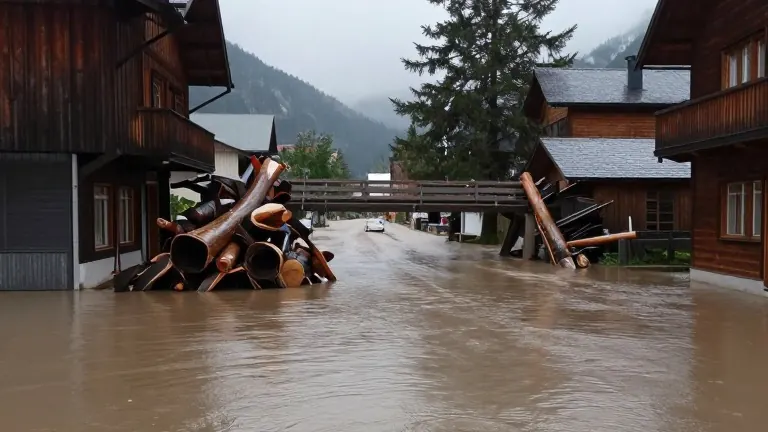
Heavy rain turned a narrow valley into a flood zone on Thursday, forcing dozens of residents to flee their homes in McCaysville, Georgia, and Copperhill, Tennessee. Governor Brian Kemp declared a state of emergency for Union, Fannin, Gilmer, and Murray counties in Georgia after the Toccoa River rose to a reported record crest of 18 feet. The rapid rise of the water destroyed property and trapped people in their homes just hours after the storm began.
The river’s speed defined the disaster. FOX 5 Storm Team meteorologist Alex Forbes reported that the water level increased by approximately 16 feet within 12 hours, with the majority of that rise occurring during a single three-hour window. This surge pushed the river hundreds of yards beyond its normal channel. The force of the current was strong enough to carry large trees, propane tanks, and other heavy debris downstream, piling them against bridges and into street intersections.
The flooding struck communities that rely on tourism and outdoor recreation. McCaysville and Copperhill share a downtown area where visitors can walk between the two states in a few steps. The area is home to the Blue Ridge Scenic Railway, which has operated tourist excursions since 1998. The river in this region hosted canoe and kayak slalom competitions during the 1996 Atlanta Olympics. The disaster occurred during the fall season, a peak time for visitors seeking to see the changing leaves in the Blue Ridge Mountains.
Residents described waking to find their homes underwater. In Copperhill, Tommy and Sandra Edwards, a retired couple who have lived in the area for more than a decade, discovered water in their home around 2 a.m. Sandra Edwards said she jumped up and came out into the living room to see their belongings floating. The couple grabbed their dog, Willow, and escaped as water rose above their deck. Tommy Edwards nearly became trapped inside. By Thursday afternoon, their home contained several inches of water, mud covered the floors, and three motorcycles had been destroyed.
Emergency crews conducted rescue operations throughout the morning. Local police, firefighters, and swift-water teams responded to calls as roads became impassable. U.S. Army Rangers from Camp Merrill in Lumpkin County, Georgia, assisted with the efforts. A military helicopter flew over the flooded area with a Ranger positioned outside the aircraft, searching for individuals in need. McCaysville Police Chief Michael Earley stated that no major injuries had been reported as of Thursday afternoon. Some residents were taken to hospitals for hypothermia, and a female firefighter was evaluated for leg pain but was expected to recover.
The event follows a pattern of severe flooding in the region. The McCaysville area experienced significant flooding in early August 2026, which damaged homes, businesses, and public buildings including the police department and post office. A boil-water advisory was issued during that event. Before that, the Ocoee River flooded Copperhill's business district in February 1990. According to a United Press International report from that time, the 1990 flood left some areas under approximately 8 feet of water, damaged 34 homes and 50 businesses, and resulted in estimated damages of $1.25 million. The river reached approximately 17.8 feet during the 1990 event, establishing a record that stood for more than three decades.
The geography of the region contributes to the severity of these floods. McCaysville and Copperhill sit in a valley surrounded by steep mountains. Rain falling on the surrounding highlands drains into streams that converge in the lower elevations where the towns are built. Forbes noted that much of the rain responsible for Thursday's flooding fell across the mountains rather than directly over downtown McCaysville. This concentration of runoff caused the river to rise rapidly, leaving little time for the water to drain downstream before additional water arrived. The approximately 18-foot crest reported Thursday appears to have surpassed the 1990 record, though final measurements remain subject to confirmation by gauge record agencies.
As of Thursday afternoon, rain was subsiding and patches of blue sky appeared across North Georgia and southeastern Tennessee. Street sweepers began removing mud and silt from roads in McCaysville, and dumpsters were positioned to collect flood-damaged materials. Propane tanks were spotted lodged beneath bridges and floating along the Ocoee River and Fightingtown Creek. In Copperhill, floodwaters washed out a culvert near Fightingtown Creek, leaving West Tennessee Avenue covered in thick silt. Authorities have not released a final accounting of the number of people displaced or the total number of properties damaged. Emergency crews continued checking neighborhoods as residents waited for conditions to improve.