Alaska Shorebird Populations Drop by Half in Three Decades
Climate shifts and habitat loss are disrupting the migration of 12 million birds that travel thousands of miles to breed in the Arctic.
By Nathan Cooper ·
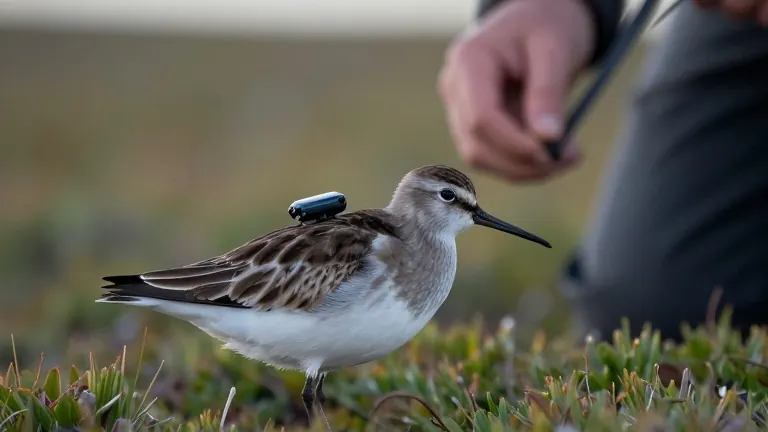
More than half of the 41 shorebird species that breed in northern Alaska have lost at least half of their population over the last 30 years, according to 24 years of tracking data compiled by researchers.
These birds, including pectoral sandpipers, fly over 17,000 miles annually between Alaska and Argentina. Weighing about three ounces, they flap their wings the entire distance rather than soaring on wind currents. Rick Lanctot, a wildlife biologist with the U.S. Fish and Wildlife Service, described the species as miraculous migrants with crazy adaptations.
Lanctot and his team monitor the birds in Utqiaġvik, the northernmost city in the United States. Field technicians attach tiny backpack-style tracking tags to the birds. These devices log GPS positions every 15 minutes and upload data when the birds pass near cell towers. Other tags, weighing as little as a grain of rice, are secured to the birds' legs like anklets.
The technology has revealed that shorebirds push the limits of survival. A bar-tailed godwit recently flew more than 8,000 miles in 11 days without stopping, traveling from Alaska to Australia. To fuel such journeys, birds double their body weight with fat and shrink internal organs like the digestive system before takeoff.
Climate change is disrupting the timing of these migrations. Spring arrives earlier in a warming Arctic, causing insects to emerge sooner. Shorebirds time their arrivals to coincide with insect peaks, but earlier springs create a mismatch. When chicks hatch late, fewer survive. Julia Berliner, a graduate student at the University of Texas at Austin, uses a modified leaf vacuum to collect insect samples on the tundra to study this shift.
Amanda Koltz, an assistant professor of integrative biology at the University of Texas at Austin, notes that insect availability changes week to week. The nutritional quality of the insects also varies, affecting the birds' ability to produce eggs. Koltz compares the nutrient differences in insects to the difference between eating a banana and a potato chip.
Robin Mongoyak, a wildlife guide who grew up in Utqiaġvik, has observed the decline for at least 35 years. The Inupiat people traditionally view the arrival of shorebirds as a wonderful time called quvianaq. Mongoyak noted that sea ice is now breaking up earlier in the spring, and temperatures in the Arctic have risen four times faster than the rest of the globe. He says he no longer sees the same number of birds he did decades ago.
Habitat loss from development and drought further threatens the species. Wetlands and grasslands used as rest stops are disappearing, forcing birds to rely on agricultural fields that may only be suitable for short periods. Nathan Senner, who studies shorebirds at the University of Massachusetts Amherst, stated that if declines continue, extinction is a possibility for many species. Researchers are now studying how birds make migration decisions to determine if they can adapt to these rapid environmental changes.
More News · Bradenton news · Report a business · Got a Story?